Showing posts with label Planetary Nebulae. Show all posts

M27 The Dumbbell Nebula


The Dumbbell Nebula (also known as Apple Core Nebula, Messier 27, M 27, or NGC 6853) is a planetary nebula in the constellation Vulpecula, at a distance of about 1,360 light-years
This object was the first planetary nebula to be discovered; by Charles Messier in 1764. At its brightness of visual magnitude 7.5 and its diameter of about 8 arcminutes, it is easily visible in binoculars, and a popular observing target in amateur telescopes.


Photograph by Max Freier
Rossington 13th July 2016
19 x 300 sec at ISO 800..
100 mm APO telescope and Canon 600D Astromodified Camera


The Bubble Nebula, NGC 7635

NGC 7635, also called the Bubble Nebula, Sharpless 162, or Caldwell 11, is a H II region emission nebula in the constellation Cassiopeia. It lies close to the direction of the open cluster Messier 52. The "bubble" is created by the stellar wind from a massive hot, 8.7 magnitude young central star, the 15 ± 5 M☉ SAO 20575 (BD+60 2522).The nebula is near a giant molecular cloud which contains the expansion of the bubble nebula while itself being excited by the hot central star, causing it to glow. It was discovered in 1787 by William Herschel. The star SAO 20575 or BD+602522 is thought to have a mass of 10-40 Solar masses.


Photograph by Max Freier
Rossington September 2015, from his new Observatory.
20 x 300 sec at ISO 800. 100mm APO telescope, with 0.85 reducer/flattener and Canon 600D astromodified Camera.
Processed with Deep Sky Stacker and Pix in Sight


M27 - the Dumbell or Apple Core nebula


Taken during a collimation session on the ODK12 on the the 6th of July 2015. I felt I'd gone as far as the conditions and eyepieces allowed on that session, and spent half an hour taking this photograph to see the result of collimation by eyepiece, on a photograph.
The camera was my Canon 550D set at ISO800. 20 frames of 60sec each, no guiding, no darks and no flats. Nor did I use my usual IDAS filter. I Sigma-added the frames in groups of 5, then averaged the 4 groups, so the result had the equivalent of 5 mins of depth. The frames were pre-processed and stacked in Astroart then finally processed in Photoshop.


M27

The Apple Core or Dumbbell  planetary nebula in Vulpecula was taken with a modified Canon EOS600 on a Takahashi 106 refractor. About 2 hours worth of 120s exposures at iso800 with flats and darks were acquired in Nebulosity, stacked in AstroArt and modified in PhotoShop 

The Owl Nebula and M108


The Owl is a planetary nebula in our galaxy some 3000 light years away. M108, an  edge on spiral galaxy, is further away at 45 million light years.This photograph was taken with a CanonEOS600 on a Takahashi106 and is a composite of 19x300s exposures, iso800 captured in Nebulosity,calibrated with flats and darks in AstroArt and finally processed in Photoshop.

Rhys Owen

PLN 85+4.1


A Planetary Nebula near the top of Cygnus, till recently at least. Not that it has disappeared, but that it has been reclassified as an HII region, an Hydrogen II nebula. It's also in the Abell catalogue as Abell71. It's  the brighter red disc in the middle of the frame. I took 26 frames of 300sec of this, thinking I'd get a small planetary in among lots of stars, but found that the exposure, just over 2 hours wasn't nearly enough, but whetted my appetite having uncovered Sharpless SH2 115 in the same frame, that's the bright extended red nebulosity at the lower central left. I'll have to get more data to add to this or restart with the centre lowered to cover the Sharpless nebula more centrally. There's so much nebulosity at the top of Cygnus. I'd relied on my hardware to find the planetary and centralise it but couldn't see any sign of it in the individual frames till stacked.
Guiding was done with PHD, success finally, and I like the results, but have to remember it doesn't like faint stars.
Taken 18.7.13 from the Austerfield Observatory, with the M25C and Tak106, then processing in Astroart and Photoshop.

Abell 39


This is tiny, well, not so tiny as planetary nebulae go (2.8 arcmins), and faint. Almost invisible in single frames of 5 mins, so I had to add 33 frames of that length, during a surprising night without cloud. In fact almost the whole of the week was without cloud. The Cloud God must be on holiday.
There was some haze though and I had 8 frames that I should have dumped because of that, but included, and have had to make processing adjustments.
Taken on 1.5.13 with the M25C in the Tak106, guided by the H9C in the Vixen260. The fat Moon rising in the dawn put a stop to it all, in fact some of the 8 hazy frames were due to that. It needs more data so I may do it all again. It hangs there in space like a green bubble. Love it.
The data was acquired in Nebulosity, then pre-processed in Astroart and finally processed in Photoshop.

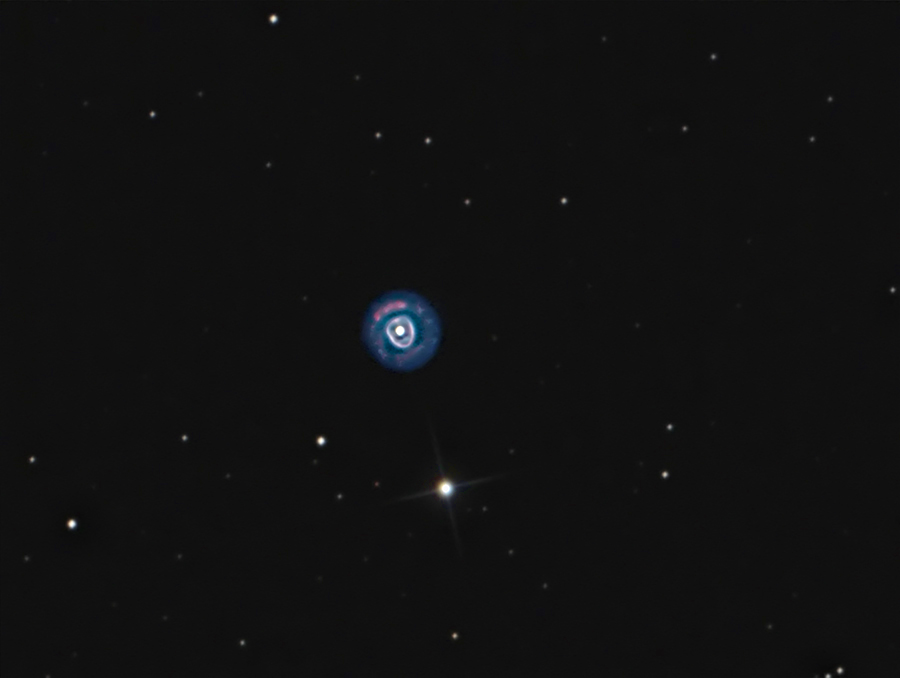
NGC 2392 - The Eskimo Nebula


The M25C was given a rest and the usual guide camera, the H9C took centre stage, in the Vixen260.
The guiding was done by the WO98 and M25C instead. though hardly needed.
The exposure was 19x90sec. Acquisition and preprocessing was done in Astroart with final processing in Photoshop. The photograph was taken on 5.01.12.