The Rosette Nebula
Taken by Rhys Owen, with a DSLR Canon 600, newly acquired and newly modified too, he obviously means business. The forecast was good, clear all night, but he must have had an inside source that told him it wasn't going to hold. He rushed in, set it all up and spent long enough focusing, and it takes some time to do it if you're using trial and error rather than software to do it.
A short couple of 30 sec shots to test and then on with a series of 20x60 sec frames at ISO800, followed by 4x60sec darks. He sat and ran them without any software control, counting them as they went. All I had to do was find the nebula and set the telescope to point at it and balance the mount suitably.
Almost as soon as he's done, the clouds started to roll in. He must have known.
The frames were stacked in Deep Sky Stacker and post processed in Photoshop to produce the final result.
13.2.13 - Aurorae in the Arctic
Taken by Rhys Owen using his Canon 400 with a 50mm lens at ISO1600 for 10sec. He had the camera sat on a tripod but the deck of the ship wouldn't keep still. Unfortunately, he wasn't able to do it again from a more stable position as they didn't reappear when the ship docked. He plans to go back and do it all again.
Kemble's Cascade - 3.2.13

A poor night of heavy haze and thin streaky cloud, but we made the best of it. Peter was in the visual dome with the others and I was in the photographic, both working on Kemble's Cascade in Camelopardalis, and here are the results of that night.Peter used a pencil and paper, his first time, while I used the Tak106 and the M25C, unguided.
Though the line of stars is easy to pick out in the eyepiece it isn't so easy on the screen from the frames taken. Though I took some 35 frames I used only 11, making the exposure 11x30sec. Processed in Astroart and Photoshop.
The drawing in fact does the object more justice than does the photograph, quite a pretty picture in the eyepiece, with the line of stars strewn either side of bright blue star, SAO 12969, and ending near the small Open Cluster NGC1502.
There were lots of arguments that night among the other observers as to its orientation on the laptop screen, as they all moved from the big Meade in the old dome to the laptop screen in the new dome to compare, but the orientation I used gets it all onto the frame in a reasonable manner. Northwards is almost exactly from the bottom left corner to the top right. I've rotated and flipped Peter's drawing to match.
30.1.13 - Fireball or Space Junk
At 9:04pm I saw a Fireball. It swept from Cancer through the bowl of the Plough, close to Kochab, then on to the top of Cygnus, though that was in too much haze to be sure, but certainly in that area. Could have got to Lacerta, all very low and in the murk.
It was very bright, very much brighter than Venus, perhaps about mag -7 or -8. Strong green head with orange-red just behind the head. It made a steady straight line as described, then at the end, it made a slight curve downwards, as though running out of power, before it faded out quite sharply. The green head was quite steady, but the orange part behind the head threw off "sparks". It had the overall shape of a very short tailed comet, but much more colourful of course. I heard no noise from it.
Was it a fireball or some space junk burning up in the atmosphere? Certainly impressive.
It was very bright, very much brighter than Venus, perhaps about mag -7 or -8. Strong green head with orange-red just behind the head. It made a steady straight line as described, then at the end, it made a slight curve downwards, as though running out of power, before it faded out quite sharply. The green head was quite steady, but the orange part behind the head threw off "sparks". It had the overall shape of a very short tailed comet, but much more colourful of course. I heard no noise from it.
Was it a fireball or some space junk burning up in the atmosphere? Certainly impressive.
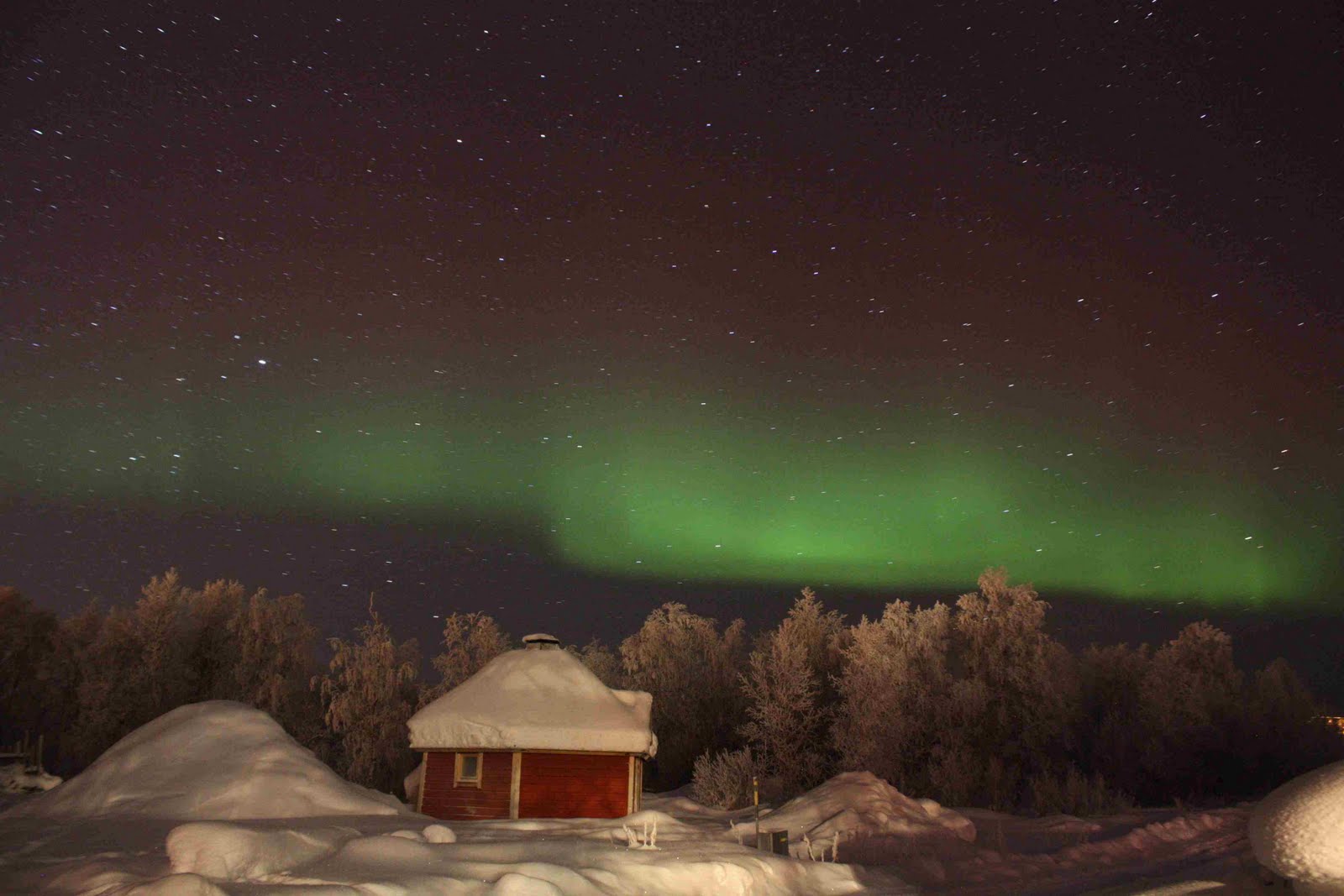
Aurora in Finland - 7.1.13
Taken by Broomstick Rider Number 1, while on a trip to Finland in search of a new Familiar. She found this Aurora among others. She says the little house is a sauna, but I think it's really an outside toilet.
Constellation Orion by Bill Hughes
At about 11:30pm, 11.12.12, I took 12 frames of Orion with my Canon 600D and 50mm. F2.8 standard lens. with 90 sec. exposures. Because the lens covers quite a large area of sky with
fairly dark at the top of Orion to lighter and more orange at the bottom, it was
extremely difficult to get rid of the gradient without also getting rid of the
detail. I think the result is quite good considering that it was taken from my
garden with all the light pollution of Doncaster surrounding
me.
Bill Hughes
Bill Hughes
9.12.12 - Sunday
A Report from Peter of general observing from the small dome at the Austerfield Observatory, while others, Dave and Rhys, were using the large dome for DSLR work.
Jupiter - Europa - 29.11.12 - 10:02pm
This was taken with the DMK camera through the Vixen VMC260L from the Austerfield Observatory. The conditions were good except for an almost full Moon spreading it's light everywhere, polluting an otherwise clear sky.
The intention was to make an animation of the passage of Europa across the face of the planet and for about an hour I took a series of 1 minute videos for that purpose. But in the final processing I found that only two were of use, the rest were not well enough focused, so have been abandoned. So please use your imagination to watch the moon and its shadow pass across the face of Jupiter.
Must do better next time. I've heard that a few times in my school life.
M42 - The Orion Nebula - 18.11.12
This is a further step on my journey to getting the hang of the Canon 550D. Not as straight forward as my SX cameras and taking more time than I though it would. On the other hand I suppose getting the hang of the SX ones took some time too, but it's all too far back in time to rememeber.
This one was taken on the 18th of November from the Austerfield Observatory, using the 550D and FSQ106, sat on the 900GTO mount. Guiding was not necessary as the exposures were a series at 10sec and another at 30sec. Both were pre-processed in Astroart5 using darks and flats, and sigma average stacked.
The final processing was done in Photoshop, and took a very long time. Not to do the actual processing, but to do it again and again, every time I changed my mind. A bit more red, a bit more blue, darker here, lighter there. Sod it! Start again! You know how it goes. This is actually version 8. There will probably be others.
In addition to PS I used GradX, can't do without that, and Annie's Astro Actions, a nice set of actions.
18.11.12 - A Record of Doubles Observing
This is an example of the records that Peter Smith makes when observing Double Stars. The form is one he devised for himself and fills out with care to develop a record of his activities. This was done on Saturday 18th of November, when all the other observers had left.
The equipment he uses is the Meade 14" with a variety of eyepieces, dependant on the subject under examination. He is very new to the task and has been working visually so far, but plans to progress by adding means of measuring separation and position.
If anyone would like to join him in this escapade, contact him, to make arrangements to meet him there, he has keys to the observatory and is not tied to our normal observing nights.
The equipment he uses is the Meade 14" with a variety of eyepieces, dependant on the subject under examination. He is very new to the task and has been working visually so far, but plans to progress by adding means of measuring separation and position.
If anyone would like to join him in this escapade, contact him, to make arrangements to meet him there, he has keys to the observatory and is not tied to our normal observing nights.
Subscribe to:
Posts (Atom)