Showing posts with label Bill Hughes. Show all posts

The Great American Solar Eclipse


Taken on 21.8.17 from a hill in Idaho USA, on 21.8.17, using a Canon 500D DSLR with a Canon 200mm F2.8 telephoto lens on a fixed tripod. For High Dynamic Range (HDR) photography I used 3 bracketed exposures of 1/128, 1/32, 1/8 sec.  at F4.  ISO 200 and the RAW images were combined in Photomatix Pro 6 software – Fusion/Natural. The detailed structure of the corona was enhanced with Topaz Clarity then ProDigital AstroFlat Pro Plugin followed by Topaz DeNoise6.


Solar Eclipse - 21.8.17


This is a couple of my photographs taken on 21/08/2017 from S. Menan Butte, Rexburgh, Idaho, USA, with a Canon 600D DSLR and a Canon 200mm. F 2.8 lens at F4. ISO 200, on a tripod. 

   The first, at Totality, was a combination of three shots of 1/8, 1/30 and 1/125s.

The second, at second contact, was a combination of two shots of 1/125s taken as the diamond ring was just disappearing and 1/30s a few seconds later. 
They were both processed in Photoshop Lightroom and Elements.

The sky at 5200 feet was completely clear and the moon’s shadow approaching at 1870 mph was an amazing sight. The temperature drop was very noticeable and the whole eclipse was a spectacular event, not to be missed.


Lunar Eclipse

Photograph taken by Bill Hughes who woke up at 2.30 am on the 28th Sep 2015 to a very misty and foggy Bessacarr.
Ever resourceful, Bill jumped in to his car and headed off to clearer skies over Wadworth to grab this amazing image of the Lunar Eclipse.
Details: 3:07am , 1/4 sec. ISO 800. with 72/432 F6 Apo refractor.


Venus and Jupiter again


This one was taken by Bill Hughes from Gringley on the Hill. He used a Canon 600D with a 200mm F2.8, lens at ISO 200. It was taken on the same night and at the same time of course. Soon after that they set together. Gringley is, as the name suggests, on an isolated hill on the plain. Venus is the brighter.


Orion Widefield Nebulosity


This photo was taken by Bill Hughes with a Canon 600D DSLR using an 80 mm f1.4 lens set at f2.0, complete with CLS filter and at ISO 3200,  only 5 exps x 176 secs each and Stacked by sigma average. 
An incredible amount of nebulosity is shown in this image and you can even clearly see the Horse Head Nebula just below Alnitak in Orion's belt.


 Taken in Tenerife on the 16th Feb 2015.

A wide field view of Orion


This is a wide view of the central region of Orion taken by Bill Hughes with a Canon 600D fitted with an 85mm f/1.4 lens set at f/2.0. The exposure was 24 x 30sec at ISO1600, stacked by adding them in 4s, then averaging the 6 groups of adds, all in Astroart, then finally processing the single file in Photoshop. North is to the left.

M31 - the Andromeda Spiral


By Bill Hughes, using a modified Canon 600D, with a 200mm f/2.8 Canon lens. The exposure was 6 x 69sec at ISO1600. Canon in-camera noise reduction was used before stacking in Astroart and finally processing in Photoshop Elements 10 with help from GradX and Topaz Denoise.


The second version is the work of Max Freier who used a Nikon 90D. The exposure was 120 x 60sec, darks taken separately. Acquired in BackyardNIKON, stacked in DSS and finally processed in PixinSight.


The third is by Rhys Owen, taken with a Canon 600D through a Takahashi FSQ106ED, for 1 x 300sec exposure. Processed in Photoshop. Is that a meteor strike?


Three different results of the same subject showing the variation obtainable through different methods and processing.
It isn't a competition, just chance that they all worked on the same subject, at about the same time.
All  pretty good considering the minimal data they all had to work with.
 

M8 and M20 in Sagittarius


This was taken by Bill Hughes from 7000' up on Tenerife while on holiday. Two jpg frames (120sec at 1600ISO) were taken and calibrated by the camera's internal noise reduction system, then stacked and processed in Photoshop. The camera was a modified Canon 500D fitted with a 200mm/f/2.8 lens.

The Moon and Saturn - 30.11.13


Taken by Bill Hughes early on the 30th of November on Hatfield Moors using an unmodified Canon 600D with a 50mm 2.8 lens for 1/4sec at ISO1600. The time was 6:42am.
An early start to try to see comet ISON after it’s conjunction with the sun. No luck with photography or binoculars, even though we went to somewhere without lights and it was a beautiful cold morning.
The star to the right of the moon is a double, Zubenelgenubi. Left is Saturn and low near the horizon is Mercury.
On the way home, a deer decided to run across the road in front of us. It resulted in a lot of damage to the deer and the car.

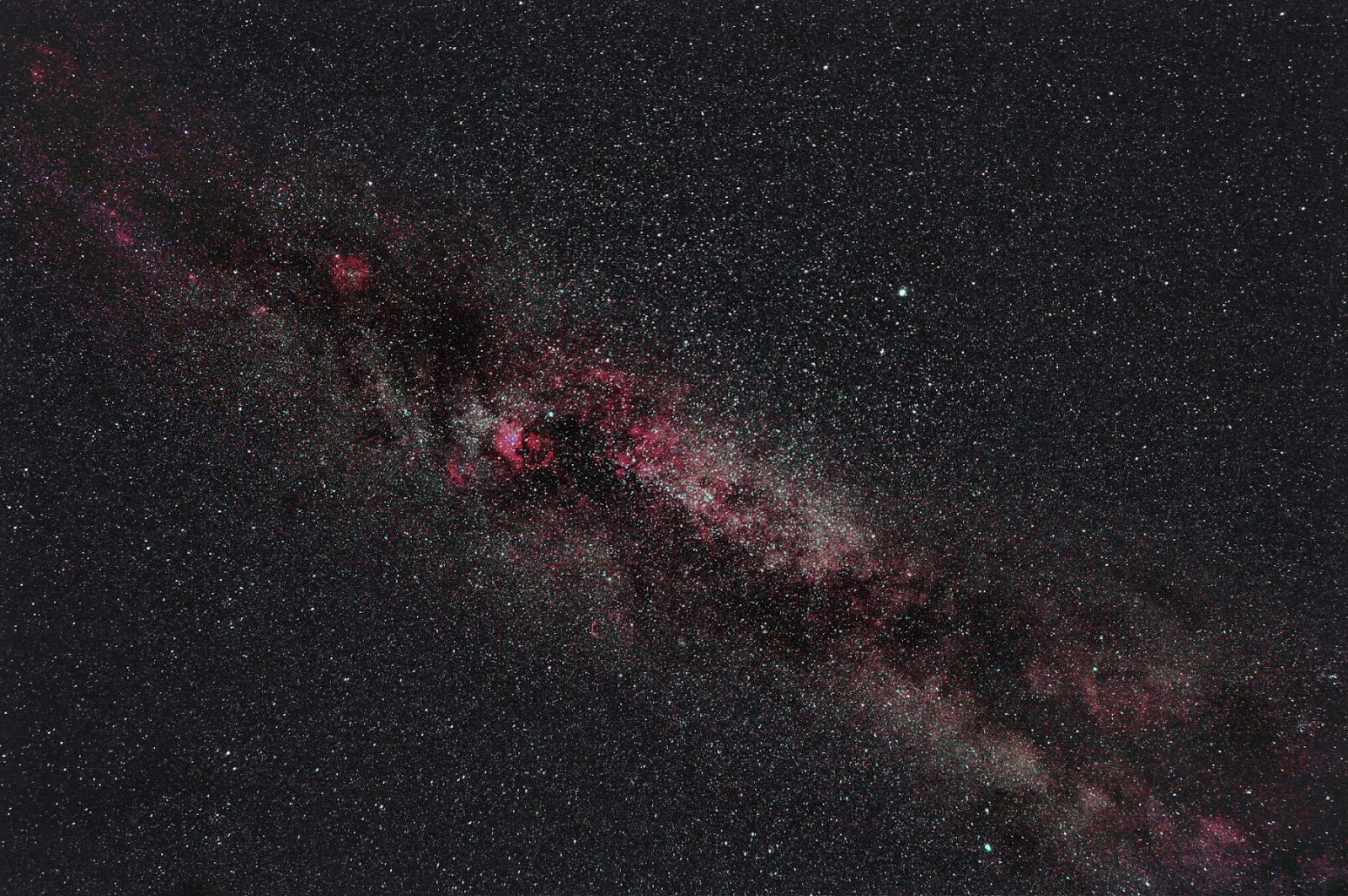
The Milky Way and the busy centre of Cygnus


This is a stack of 9 x 1 min. taken on 8.8.13, from Bessacarr by Bill Hughes, under Sodium Vapour street lights. The camera was set at ISO 1600, with a 50mm. F2.8 and an LPR filter.
See if you can pick out the nebulous areas, the largest and brightest is the North American Nebula, NGC7000, near the middle left with the Butterfly, NGC1813d, lower to the right.


Another by Bill Hughes from the same location and using the same camera with the gain set at ISO1600. The same street lights were doing their best to spoil things too. The lens fitted for this was a 14mm f2.8, so drawing in a much larger area of sky. The exposure was 10x1min. Again see what features you can recognise.

In both cases the processing was done in Deep Sky Stacker followed by Photoshop.