NGC7000

Further testing with the Takahashi focal reducer, taken on 7.9.13 from the Austerfield Observatory. With my M25C I usually get only the upper large part of the nebulosity, the North American (Buffalo) and a touch of the Ferret, but the FR embraces a field a good bit wider without costing much in resolution. I'd hoped to include some nebulosity further to the left, south, of the snout of the Buffalo, but failed. The guiding was done with the H9C on the Vixen with an AP .62 Focal reducer controlled by Astroart5.
Flats and Bias frames were used in the calibration in Astroart, with final processing done in Photoshop.
Not the greatest, but certainly a success for me in terms of a useful piece of kit proved out.

SH2-129


 I recently bought Dave Adshead's focal reducer for my 106 but it wouldn't focus when used with my M25C camera. And after a prolonged series of trials with different spacers etc., with a dealer of Takahashi telescopes, this is the final test on a faint area of nebulosity in Cepheus recorded in the second catalogue of Stewart Sharpless of "bright" nebulosity. It's also known as the Flying Bat, and is far more extensive than this frame of the brightest part. The FR gives the telescope a focal length of 387mm, but this bit of nebulosity would need a focal length of 150 to 250mm, so mosaicking or a camera lens would be the solution. But I've not enough patience for doing mosaics so I may try my old 135mm Pentax lens, some time in the future.
The night was cloudless but with haze, though the Milky Way could be seen all night. The dew was heavy too, and the car was wringing wet.
The exposure was 220 mins in total, and the guiding was done by my trusty H9C and Astroart. Stacked in Astroart and finally processed in Photoshop.


M17 - the Swan


Taken by Rhys Owen on the 13th of August, from home using a modified Canon 600D DSLR with an Astronomic CLS filter on a Takahashi FSQ106ED. The exposure was 30x60sec at ISO1600 and recorded in Nebulosity. Then calibrated with 5x60s darks and stacked in Astroart, and finally processed in Photoshop.

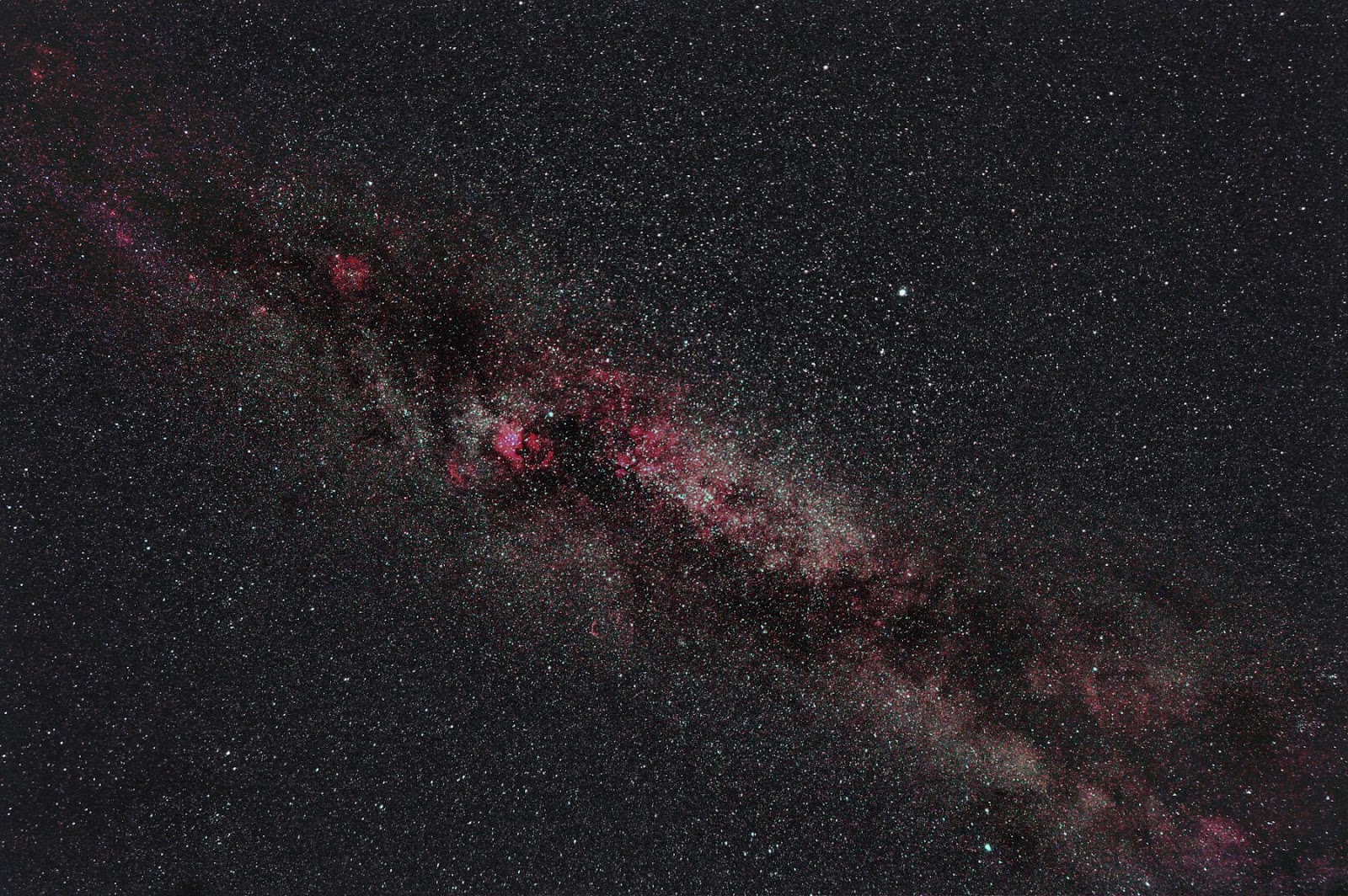
The Milky Way and the busy centre of Cygnus


This is a stack of 9 x 1 min. taken on 8.8.13, from Bessacarr by Bill Hughes, under Sodium Vapour street lights. The camera was set at ISO 1600, with a 50mm. F2.8 and an LPR filter.
See if you can pick out the nebulous areas, the largest and brightest is the North American Nebula, NGC7000, near the middle left with the Butterfly, NGC1813d, lower to the right.


Another by Bill Hughes from the same location and using the same camera with the gain set at ISO1600. The same street lights were doing their best to spoil things too. The lens fitted for this was a 14mm f2.8, so drawing in a much larger area of sky. The exposure was 10x1min. Again see what features you can recognise.

In both cases the processing was done in Deep Sky Stacker followed by Photoshop.

M39 - in Cygnus


Taken on the 5th of August 13, as a finish off to a 4 hour job, when the sky was dying out.
The usual kit was used, M25C in the 106 and the H9C guiding with a .67 focal reducer in the Vixen 260.
Stacked in Astroart with bias and masterflat and processed in Photoshop. The exposure was 11x120sec.

IC4665 in Ophiuchus


A wide cluster of blue stars, not many but clearly blue. Taken from the Austerfield Observatory on 5.8.13, with an M25C in a Tak106 at native FL. Guided by an H9C in a Vixen VMC260L with a .67 focal reducer. Nebulosity controlled the taking camera and Astroart the guiding one. Stacked in Astroart and processed in Photoshop. The spikes are of course artificial. Perhaps worth more time on it to highlight the dust lanes more.

NGC1318d in Cygnus


Taken on 3.8.13 from the Austerfield Observatory with the Tak106 and M25C. Not a great night, hazy and with intermittent cloud. Guided by an H9C in the VMC260 with a .67 focal reducer. The focal reducer helped find and hold stars by brightening them through the haze, but couldn't help it see through clouds. The small cluster to the lower left is NGC6910.
North is to the right with extremely bright Sadr cropped to just a glow at the bottom edge of the frame. The exposure was 21x300sec, stacked in Astroart and processed in Photoshop.

PLN 85+4.1


A Planetary Nebula near the top of Cygnus, till recently at least. Not that it has disappeared, but that it has been reclassified as an HII region, an Hydrogen II nebula. It's also in the Abell catalogue as Abell71. It's  the brighter red disc in the middle of the frame. I took 26 frames of 300sec of this, thinking I'd get a small planetary in among lots of stars, but found that the exposure, just over 2 hours wasn't nearly enough, but whetted my appetite having uncovered Sharpless SH2 115 in the same frame, that's the bright extended red nebulosity at the lower central left. I'll have to get more data to add to this or restart with the centre lowered to cover the Sharpless nebula more centrally. There's so much nebulosity at the top of Cygnus. I'd relied on my hardware to find the planetary and centralise it but couldn't see any sign of it in the individual frames till stacked.
Guiding was done with PHD, success finally, and I like the results, but have to remember it doesn't like faint stars.
Taken 18.7.13 from the Austerfield Observatory, with the M25C and Tak106, then processing in Astroart and Photoshop.

NGC6633


This was taken on 16.7.13 from the Austerfield Observatory, using a Tak106 and M25C. The guiding was done with an H9C in the Vixen260 controlled by Astroart. I've been trying to get PHD to work for me but have so far failed, I think because the stars seen through the Vixen have mostly been too small for PHD, though Astroart manages with them.
We've had a heat wave recently lasting for several days, and we're not used to it. It has filled the skies with haze and dust so photography has been compromised severely, even though there haven't been any clouds. I've also been trying to get my DSLR to perform, again without success. So here is a return to "normality", and an Open Cluster near the top end of Ophiuchus, small but neat and blue. Stacked by Sigma Average in Astroart and finally fiddled with in Photoshop.
Note the long diagonal string of stars to the right centre. The Joynes String?

The Sun on 4.6.13


Another one of the Sun taken from Austerfield with the DMK camera and PST telescope, 60sec of video on two parts that had to be stitched together. I'm beginning to understand the settings to get the best of it.
Processed in Registax6 with final adjustments in Photoshop. The camera is monochome so the colour was added separately in Photoshop.